

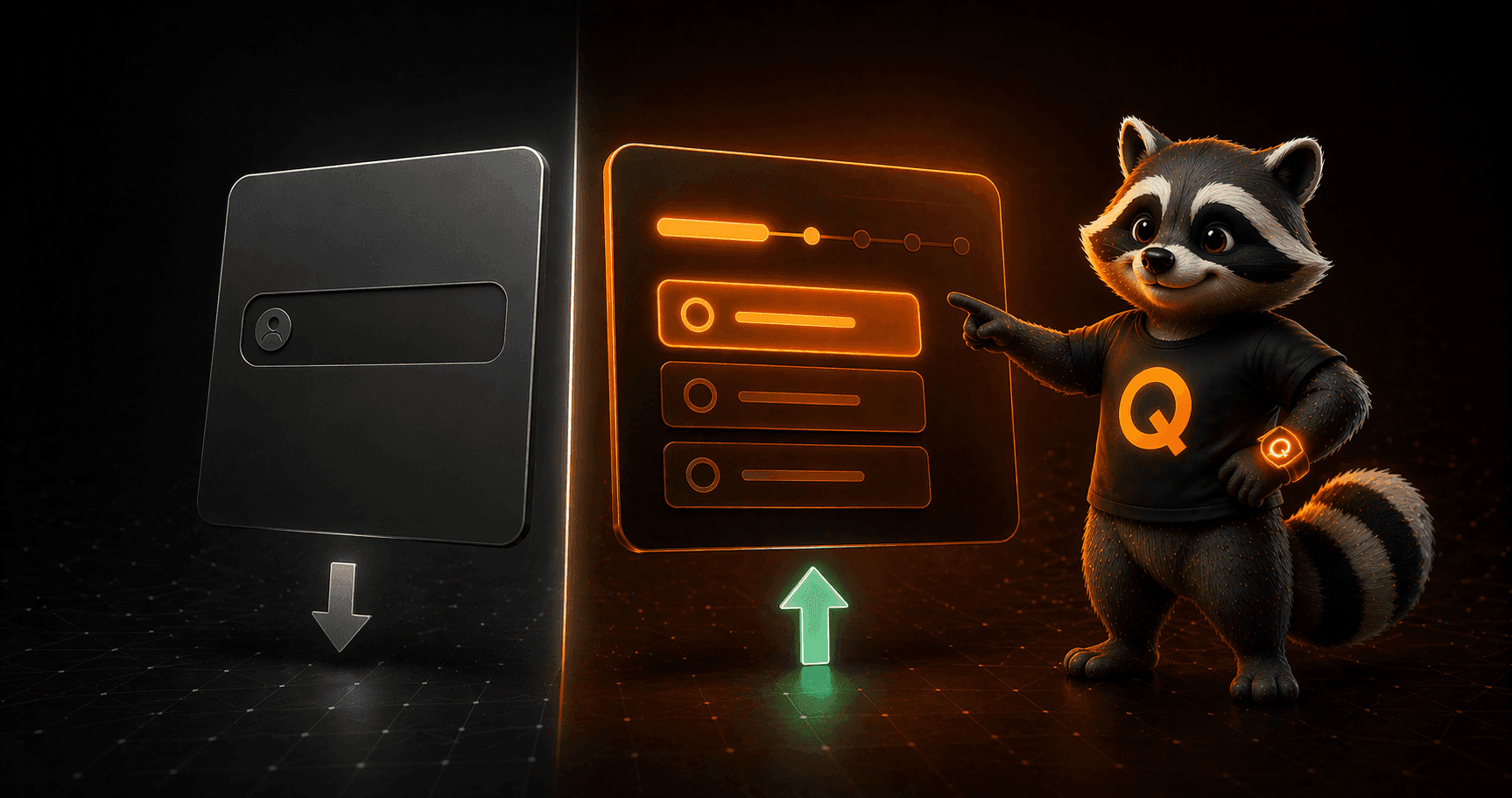
Marketers have debated for years: what captures more leads — a simple contact form or an interactive quiz? The answer depends on context, but data from 2024–2026 sends a clear signal: quizzes outperform forms in most niches.
Here is why — and when the exceptions apply.
What Is a Contact Form and What Is a Quiz
A contact form is fields for "Name," "Email," "Phone," plus a "Submit" button. A classic that has existed since the 1990s.
A quiz is a series of questions that:
- Draws the person into a conversation
- Personalises the result to their situation
- Collects contact details at the end, when interest is at its peak
The Data: Quizzes vs Forms
| Metric | Contact Form | Quiz |
|---|---|---|
| Average conversion rate | 2–5% | 25–40% |
| Completion rate | — | 55–70% |
| Lead quality | Low | High |
| Cost per lead | High | Lower |
| Time on page | 20–40 sec | 2–4 min |
Data based on Demand Gen Report (2024) research and internal Qwizoo platform analytics.
Why Quizzes Convert Better
1. The Commitment and Consistency Principle
When someone answers the first question, they are already psychologically "in the process." Going back means admitting they wasted their time. That is why 55–70% of people who start a quiz reach the end.
A form does not create this effect — the person either fills it in or does not.
2. A Personalised Result = Motivation to Share Contact Details
A quiz offers: "Find out your result." A form offers: "We'll be in touch." The difference is enormous.
The person understands they will receive something specific and personal — not another "a manager will call you back."
3. Segmentation Happens Automatically
Quiz answers give you:
- The client's budget
- Their current situation
- Their main problem
- Their readiness to buy
A form gives you only an email. And then you are not sure what to do with it.
- The client answers 5–7 questions
- The system automatically segments them in your CRM
- The manager opens the card and already knows: budget $5,000, looking for a turnkey solution
- The first call starts with context, not from a generic script
When a Form Works Better Than a Quiz
There are situations where a classic form will outperform:
1. Motivated traffic — if someone has come from a paid search ad for a specific service and is ready to buy. An extra quiz step can only get in the way.
2. B2B with a long sales cycle — if a potential client wants to speak with a manager rather than receive an automated result.
3. Referral traffic — when you already have a warm lead and simply need their contact.
In all other cases — the quiz wins.
Real-World Case: Real Estate Agency
A real estate agency used a standard "Submit enquiry" form on their landing page.
Before the quiz:
- 3.2% conversion rate
- 60% of leads were "non-target" (price, neighbourhood, size didn't match)
- Managers spent 40% of their time on qualification
After introducing a "Find an Apartment" quiz:
- 28% conversion rate (+775%)
- 85% of leads immediately segmented by budget and neighbourhood
- Qualification time reduced by 60%
How to Build a Quiz That Converts
For a complete walkthrough, see our step-by-step guide to creating a lead generation quiz.
The 5–7 Question Rule
The optimal number is 5 to 7. Fewer — not enough personalisation. More — people drop off.
First Question — Easy and Engaging
The first step should be simple. "What is your main goal?" with answer options — perfect. Do not start with questions about budget or phone number.
Lead Form — Second-to-Last Step
Do not show contact fields at the start. Let the person reach the end, build their interest — and only then ask for an email.
Result — Specific and Valuable
"Your result: Type B" means nothing. "For your business, a quiz with 6 questions and a B2B branch works best — here's why" is valuable.
Conclusion
A quiz is not just a "trendy form." It is a tool that:
- Engages more people (higher CR)
- Delivers better leads (built-in segmentation)
- Shortens the sales cycle (the manager already knows the context)
Contact forms remain useful for specific scenarios. But for most landing pages and websites, a quiz is the choice that pays back in the very first month. Next step — embed it on your site without a developer.